In September, we attended a conference all about variation in spoken and signed languages. It is a conference which happens once every 2 years called United Kingdom Language Variation and Change (UKLVC).
We presented about two things. Rose presented a talk about the findings from the Sylvester and Tweety project which looked at the use of classifiers – handshapes used to represent Sylvester the cat and Tweety the bird, which can move around in space (not the signs for “cat” or “bird”). More specifically, we looked at when signers choose to use the handshape with index and middle fingers extended downwards (showing two legs standing, called “2-handshape”) and when they use the handshape with index finger extended (showing the body of a character, called “1-handshape”). We found that signers use the 2-handshape more than the 1-handshape. There are certain linguistic and semantic factors which affect which handshape is used by signers. We also show that younger ISL signers are more likely to use their hands to represent characters whereas older signers are more likely to use their bodies.
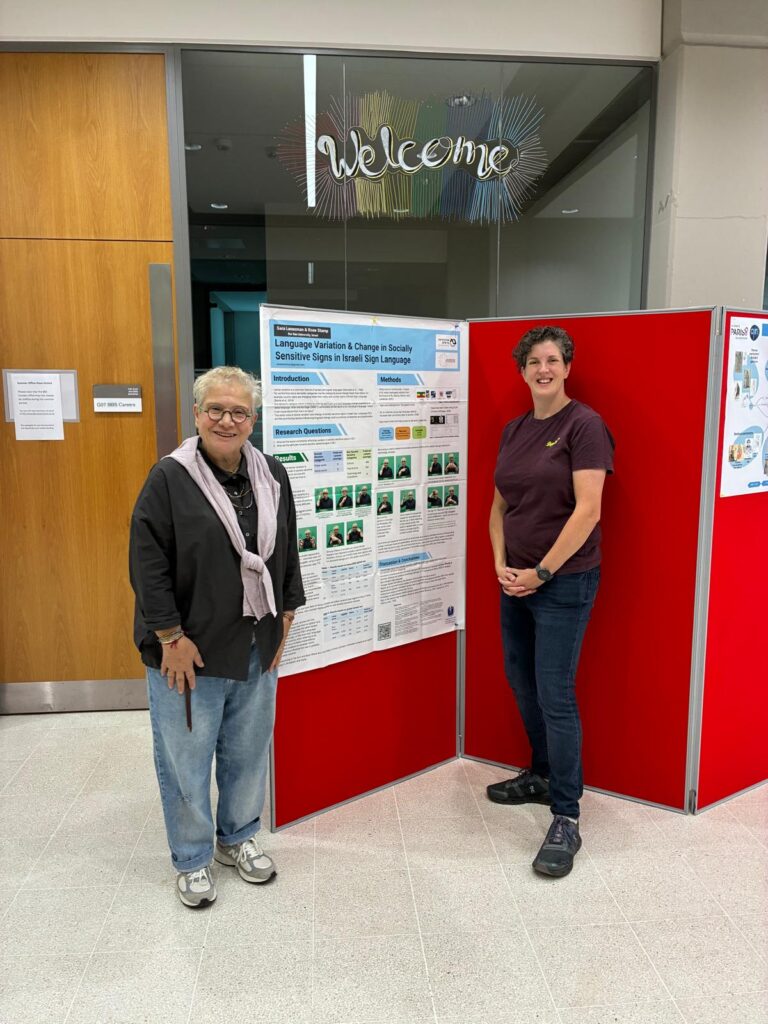
Sara also presented about her PhD research in a poster style – this is like an informal presentation where people walk around and look at poster summaries of the research. Take a look at ours here.
In addition, a master’s student called Yuanmeng Ma presented her findings from analyzing the conversations in the Corpus. She found that when men and women are paired together in a conversation often the man, rather than the woman or an older person, rather than a younger person, will interrupt the other person. This is similar to what has been found in spoken languages. She also found that signers tend to sign at the same time as each other more often than speakers speak at the same time as each other, suggesting that this type of conversing is more acceptable in sign languages.
Well done to Yuanmeng Ma for completing her MA in Linguistics at Bar Ilan University this year! She also submitted her findings to a journal (in the hope it will be published soon!) called Sign Language Studies – fingers crossed!